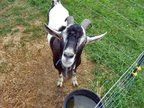
Today, more and more people are discovering the fun in raising goats. It was not too long ago when goats are among the lowest on the list of pet animals. Now, raising goats are suddenly on the upswing, either as pets or even as a business. Unfortunately, many people do not know a whit about proper goat care.
Thanks to dedicated farmers and other goat lovers, taking care of goats are discovered to be not that difficult.
Short history
Goats are said to be one of the oldest animals domesticated by man. They provide milk, meat, hair and skin. Aside from drinking, goat’s milk can be processed into butter, ice cream and cheese.
The bucks (males) have strong smell and will affect the milk of does (females) if they are not separated. The kids (young goats) are playful and curious and can be trained not to fear people. The wethers are castrated males.
Food
For non-free range goats, feeding is done twice daily. Some raisers mixed their own goat food consisting of crimped oats, dairy goat pellets and some sunflower seeds.
There must be water for them all throughout the day. (Cool fresh water in summer and warm water in winter.)
Goats must also have hay available to them all day. Raisers usually provide a mixture of alfalfa, Timothy and orchard grass. Food and water must be placed on sturdy upraised feeders where the goats cannot soil them.
Since they are browsers, goats are ideally raised free-range where they rummage through all kinds of grass, leaves, and bush plants. Carefully check which plants in the area are toxic to them.
Shelter
Goats hate rain and mud. They need a proper shed to protect them from rain, snow and (cold) wind.
Some owners keep cabinets inside these shelters for goats to sleep off the ground. Goats love warm and dry places. It is important to keep these places always clean and dry to keep off bacteria.
Outside these shelters, there should be some place for your non-free range goats to roam and frolic. A small rock pile and some other objects for them to play-jump with would be ideal.
Health
Kids (young goats) should be properly immunized, usually with Bar-Vac CDT (clostridium perfringens types C & D tetanus toxoid). At one year old (and every year thereafter), they should get a booster Bar-Vac CDT injection.
They need to be de-wormed at least four times a year. De-wormers also kills external parasites (lice, ticks, fleas, etc).
Don’t overfeed your goats because they will accumulate gas. (Baking soda usually relieves this.) Baking soda helps goats in their digestion and keeping in check their urine acidity. Goats know when they need to eat baking soda and how much they need.
A healthy goat has bright eyes, smooth and shiny coat, with a good appetite, and alert. Teary or cloudy eyes might mean infection.
A dull coat might mean they have parasites. Hunched backs and droopy tails indicate something is wrong, especially if they refuse to eat.
Other tips
Never raise a single goat. Goats are herd animals. Keep as many as you can. They have different personalities, are affectionate, and hang around people to get a good scratch. Goat care is not a chore.
Selengkapnya...
Saturday, August 28, 2010
A Short Guide On Goat Care


Saturday, February 21, 2009

The Cheviot originated in the Cheviot Hills, on the border of England and Scotland. Recognized as a hardy sheep as early as 1372, Cheviots did well in those bleak, windswept conditions, with their strong constitution, easy lambing, well developed mothering instinct, and fast maturity. Introduced to Australia in 1938, the Cheviot has proved its ability to withstand the cold, wet Winters of Southern Australia, and is a vigorous forager through the hot, dry summers, when feed is scarce. The breed was introduced into the United States in 1838 from their native Scotland.
The Cheviot is a distinctive white-faced sheep, with a wool-free face and legs, pricked ears, black muzzle and black feet. It is a very alert, active sheep, with a stylish, lively carriage.
The Cheviot is a long-wool type, hornless and of reasonable frame. Initially it developed some popularity in Australia as a sire of top quality prime lambs as well as for crossing with Merinos to produce prime lamb mothers.
Cheviot wool has a distinctive helical crimp, which gives it that highly desirable resilience. Cheviot wool is often blended into other yarns to give resilience and durability to the finished article. The fleece is dense and long-stapled, of 56s-50s quality, and springy to the touch. These special properties also help reduce fleece rot and fly strike problems.
Bred to look after themselves, Cheviots need less husbandry. Their ease of lambing and strong mothering instinct means fewer lambing problems. Hard black feet make them less prone to foot rot. Their tendency for worm resistance means less drenching, less crutching and less fly strike. With wool-free faces, Cheviots never suffer from wool blindness.
Physical DescriptionMature body weight for the rams is 160 to 200 pounds (72-90 kg) with the ewes weighing slightly less at 120 to 160 pounds (55-72 kg). Mature ewes will average a five to ten pound (2.25-4.5 kg) fleece that has a micron measurement of 27.0 - 33.0 and a spinning count of 48-56. The staple length of the fleece will be three to five inches (7.5-12 cm) with a yield of 50 to 75 percent.
Cheviot Breed Associations and Registries
Reference:
Handbook of Australian Livestock, Australian Meat & Livestock Corporation,1989, 3rd Edition
British Sheep Breeds (poster), British Wool Marketing Board, Oak Mills, Station Rd., Clayton, Bradford.
Cheviot Sheepbreeders' Association of Australia, Peter Simpson RMB 404 Oura Rd WAGGA WAGGA Australiaweb: http://www.ansi.okstate.edu/breeds/sheep/cheviot/redir.aspx?C=7e207e6fc188485390d8d668cd0b77f2&URL=http%3a%2f%2fwww.cheviotsheep.com.au
Who's Who in U.S. Sheep Breeds(poster), American Sheep Industry Assn., Inc.; 6911 S. Yosemite St. Suite 200; Englewood, CO 80112-1414 Phone: (303) 771-3500 FAX: (303) 771-8200Photographs:
Handbook of Australian Livestock, Australian Meat & Livestock Corporation,1989, 3rd Edition
British Sheep Breeds (poster), British Wool Marketing Board, Oak Mills, Station Rd., Clayton, Bradford.
[Sheep Breeds Breeds of Livestock Animal Science Home Page Comment ]
Selengkapnya...
Sunday, January 4, 2009
domba
Cina : Baru-baru ini sebuah foto seorang penggembala dengan kawanan domba menjadi perbincangan hangat di Cina. Apa yang membuatnya menjadi buah bibir?Adalah Du Hebing, yang mengambil foto tersebut. Awalnya ia hanya iseng ketika mengambil gambar tersebut.“Setelah mengunjungi Taman Binatang Buas, dalam perjalanan pulang saya melihat sekawanan domba berjalan. Ternyata dibelakang domba tersebut ada seorang pria yang sedang memegang sebingkai foto sambil mengikuti domba-domba tersebut dari belakang” ujarnya. Setelah mengambil gambar tersebut, tiba-tiba Du tertawa. Ternyata dia baru menyadari kalau foto yang dibawa pria itu adalah seekor serigala.“Pria itu memakai foto serigala untuk menakut-nakuti domba tersebut dan mengarahkannya ke domba. Ini adalah sesuatu yang sangat lucu” kisah Du Hebing. Kemungkinan besar penggembala tersebut mencoba berhemat. Alasannya karena tidak bisa membeli seekor anjing. Namun ide yang digunakan penggembala ini patut diacungi jempol. Mungkin dia salah satu penggembala Selengkapnya...